Solitaire Strategy: How to Win
In a Solitaire race, the first player to get every card home wins. Every deal here can be won, so the question is how fast you find the way through.
The one thing that matters most
Turn over the face-down cards. A card you cannot see is a card you cannot use, and the game finishes itself once nothing in the columns is face down and the rest can all go home.
So when you have a choice of moves, take the one that turns a card over. When two moves both do, take the one from the column with more cards still face down.
Read the table before you draw
Look across the seven columns before you touch the stock. Send any ace home. Then look for a face-up card or run that can go onto another column and uncover a card.
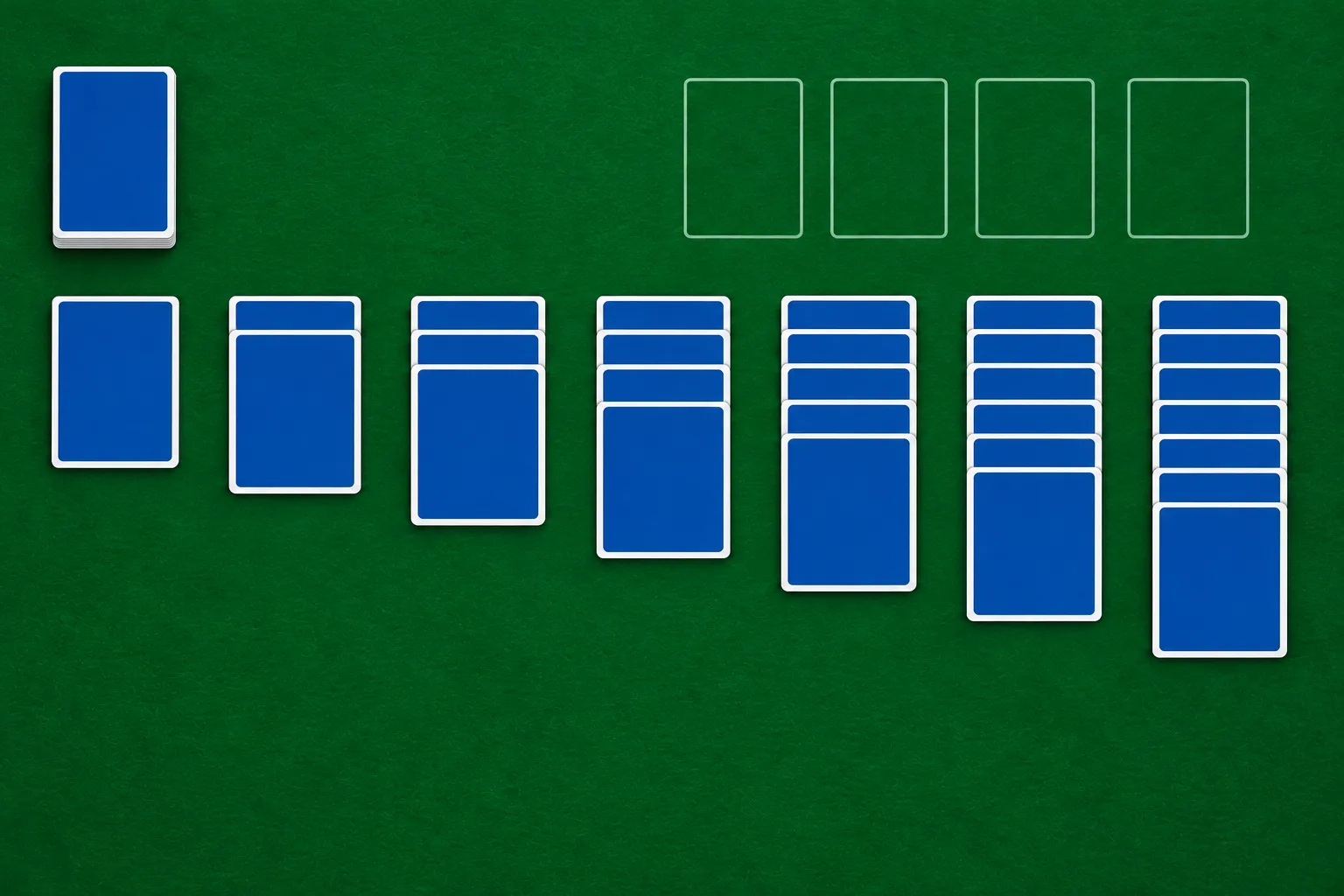
The columns on the right start with the most face-down cards. The seventh has six. Those are the ones to dig into first.
Draw when the table has nothing more to give. After each card you play from the waste, look at the columns again, because it may have opened a new move.
Empty columns and kings
An empty column takes a king, or a run that starts with a king, and nothing else. An empty column with no king to fill it does nothing for you. Do not clear a column unless a king is ready, in the columns or on the waste.
A king that sits on face-down cards is worth moving, because the move turns a card over. A king already at the bottom of its column gains nothing by moving to another empty one.
When you have a choice of kings, think one step ahead. A red king needs a black queen next, then a red jack. Pick the king whose next cards you can already see.
Working the stock
You can go through the stock as many times as you like, with no penalty, so nothing in it is ever lost. The cost is time: every draw is a tap.
With draw one, you can reach every card in the stock on every pass. Play a card from the waste when it helps the columns, and keep going.
With draw three, you can play the top card of each three. The waste turns over in the same order, so the same cards come up on the next pass unless you play one. Playing a card shifts every card after it by one place. If the card you need is out of reach, play a different card from the waste earlier in the stock, and a new set of cards comes up next time.
The waste shows up to three cards spread out. Before you play the top one, look at what lies under it. Playing the top card makes the next one playable.
When to send a card home
Aces and twos can go home at once. Nothing in the columns needs them.
For higher cards there is a simple test. A card is safe to send home when both cards of the other color, one rank lower, are already home. A red five is safe once both black fours are home. Before that, you may still need the red five in a column to hold a black four.
If you send a card home too soon, you can bring it back. The top card of a foundation can come down onto a column where it fits.
With a time limit, cards home decide the places when nobody finishes, and a tie goes to whoever reached the count first. As time runs low, send home everything that will go.
Undo is a tool
Undo has no penalty and reaches a long way back. Draws can be undone too. Use it freely.
- Stuck between two moves? Try one. If it leads nowhere, undo and try the other.
- Not sure a move is worth it? Make it, see which card turns over, and undo if it does not help.
- A note says no moves are left? Undo a few moves and take a different turn. The deal can be won, so a way through exists.
- Each undo costs a moment. In a race, a quick try and undo beats a long think.
Hint mode in a race
Hint mode lights the next move of a winning line and keeps it lit. Tap the lit cards and they go where the hint says, so you can follow a line one tap at a time. Follow it to the end and you win.
The lit line is a winning line. It is not always the shortest one. A player who sees a quicker way can still beat someone who follows every lit move.
If you step off the line, hint mode looks for a new one from where you are. If the undo button lights up instead, it found none. Undo until a move is lit again.
A good habit: play your own game, and turn the bulb on when you stall. Take the lit move, then carry on. Hint mode is open to every player, so a room that wants a pure race can agree to leave it off.
Racing tactics
- Tap instead of dragging. A card that can go home goes home on a tap, and a card with one place to go moves there.
- Do not tidy up. A move that turns nothing over, frees nothing and sends nothing home is a wasted tap.
- Aim for the last face-down card, not for a full set of foundations. Once nothing is face down and the rest can go home, the game plays the finish for you, faster than you could by hand.
- Watch the strip. It shows how many cards everyone has home. With a time limit, it tells you when to stop setting up and start sending cards home.
- Use a pause if the room needs a break. Every table is covered while the race is paused, and paused time does not count on your clock.
Common mistakes
- Drawing before reading the table.
- Emptying a column with no king to put in it.
- Building one long run while the big columns on the right stay face down.
- Sending a middle card home and then needing it in a column. Bring it back down when that happens.
- Thinking too long. Undo has no penalty, so try the move.
- Stopping when a note says no moves are left. Undo instead. The deal can be won.
Beating the bots
A bot plays a winning line for the deal from the first card to the last. It is the same line hint mode lights from the deal. What changes with the level is the pace.
An easy bot takes several seconds a move, stops to think, and now and then makes a move it takes back. A steady player beats it. A medium bot is quicker and slips a little less. A hard bot plays about a move a second and never slips.
You have one thing the bots do not. A bot plays its last cards home one move at a time, at its own pace. Your finish plays itself, fast, as soon as the table allows it.
To beat a hard bot you need quick taps and few wasted moves. Start against easy bots, then move up.
Playing with a group or with kids
Draw one is the friendlier game. Pick it for a mixed group or with kids. Draw three is harder, for a room that wants a longer puzzle.
A time limit of 5 or 10 minutes keeps a party moving. When it runs out, the most cards home wins, so everyone has a place even if nobody finishes.
With kids or new players, turn on hint mode together. Each lit move shows a rule at work: red on black, one rank down, kings into empty columns.
On a TV at a party, the room can watch every table fill in side by side.
Quick tips
- Turn over face-down cards before anything else.
- Dig into the columns with the most face-down cards.
- Read the table before every draw.
- Keep an empty column for a king.
- Aces and twos go home at once. Higher cards go when both cards of the other color, one rank lower, are home.
- Try a move and undo it rather than stare.
- Turn on hint mode when you stall.
- With a time limit, send cards home as time runs low.
Questions
- How do you win at Klondike Solitaire?
- Turn over the face-down cards as fast as you can. Take moves that uncover a card, dig into the columns with the most face-down cards, keep empty columns for kings, and read the table before every draw. Once nothing is face down, the rest usually falls into place.
- What is the best first move in Solitaire?
- Play what is on the table before you draw. Send any ace home, then make the move that turns over a face-down card, starting with the columns that have the most of them.
- Should you always move cards to the foundation?
- Aces and twos, yes. A higher card is safe once both cards of the other color, one rank lower, are home. Before that you may still need it in a column. Here you can bring the top card of a foundation back down if you sent it too soon.
- Is draw one or draw three easier?
- Draw one. You can reach every card in the stock on every pass. With draw three you can play the top card of each three, so a card can stay out of reach until you play the cards over it.
- What do you do when you are stuck in Solitaire?
- Undo and try another way. Every deal here can be won, and undo has no penalty. You can also turn on hint mode, which lights the next move of a winning line, or tells you to undo when you are off it.
- Is it fair to use undo and hints in a race?
- Yes. Both are open to every player and neither carries a penalty. A room that wants a harder race can agree to leave hint mode off.