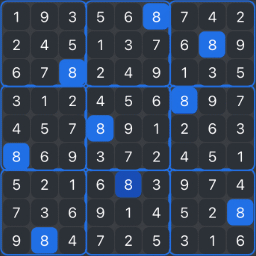
Sudoku Strategy: How to Win
In a Sudoku race, the fastest finish wins. Misses cost you only a moment, so the player who keeps moving usually beats the player who solves perfectly but slowly.
The one thing that matters most
Never stop moving. Your time is the only thing that decides the winner. Misses do not add time, and your score does not count toward the ranking.
So the best players do not stare at one hard cell. They place the easy numbers first, everywhere on the grid, and let each one open up the next. When you get stuck in one spot, look somewhere else.
Start with a number sweep
The fastest way into any puzzle is to pick one number and chase it across the whole grid. Tap a cell that already holds that number, and every copy of it lights up. Now you can see which rows, columns and boxes already have it.
Look at each box that is still missing the number. Cross out, in your head, every row and column that already holds it. If only one empty cell in the box is left, that is where the number goes.
Start with the number that appears most often in the givens. It rules out the most cells, so it fills in fastest. The small count under each button on the number pad tells you how many of each number are still to place. A low count means that number is nearly done and easy to finish.
Naked singles: one number left for a cell
A naked single is a cell where only one number fits. Look at its row, its column and its box. If eight of the nine numbers already appear across those three, the ninth is the answer.
The notes can do this check for you. Turn notes on for a cell and it shows every number still possible there. If only one small number shows, place it.
Hidden singles: one cell left for a number
A hidden single is the other way around. A cell may still have several options, but one of those numbers has nowhere else to go in its row, column or box.
Say a box is missing a 4, a 6 and a 7. If the 6 is blocked from every empty cell in that box but one, that cell is the 6, even if a 4 or 7 could also fit there.
Pairs: when two cells share two numbers
On hard and expert puzzles you will reach a point where no single shows up. That is when pairs help.
If two cells in the same row, column or box can each only be the same two numbers, say 3 and 8, then those two numbers belong to those two cells. Nothing else in that row, column or box can be a 3 or an 8.
The notes on this site only rule out numbers already placed in a cell’s row, column and box. They do not know about pairs. So when you spot a pair, remember that a 3 or 8 showing in another cell’s notes nearby is not really possible there. That often leaves that other cell with just one real option.
Using notes well
Notes here fill themselves in and update as you play, so they never go stale. That makes them cheap to use.
- Turn notes on for the empty cells in your most crowded box or row. Any cell showing a single number is a free placement.
- Watch notes as you place numbers. When you fill a cell, the notes around it shrink, and new singles appear.
- Look across the notes in a row or box for a number that shows up in only one cell. That is a hidden single.
- Do not turn on notes for the whole grid at the start. A cell with many small numbers is hard to read and slows you down. Turn them on where the grid is already crowded.
Racing tactics
- Go wide, not deep. Fill what is easy across the whole grid before you work on the hard spots.
- Finish what you start. When a number has one or two left to place, find them. Finishing a number makes every other cell easier to read.
- Follow the chain. Every number you place may create a new single in the same row, column or box. Check those first, while they are fresh.
- On a computer, use the keyboard. Press 1 to 9 to place a number in the selected cell. It is faster than reaching for the pad.
Speed versus mistakes
A wrong number never goes into the grid. It flashes red, counts as a miss, and you carry on. Misses have no limit and do not change your place.
That changes the math. If a cell has only two possible numbers and you cannot quickly tell which, try one. If it is wrong, it bounces back, and you know the other one is right. That takes a second. Working it out properly can take much longer.
When a hint is worth it
Hints are free, but the clock keeps running while you read them. A hint steps through the cell’s row, column and box before it gives the answer.
Use a hint when you have been stuck for longer than the hint would take to read. On a hard or expert puzzle, that is often worth it. Step through it quickly with the arrows.
Pick the cell for the hint with care. Ask for one on a cell in a crowded area. If only one number is left there, the last step places it for you. On an open cell, the hint may end with notes instead of an answer, and you have spent the time for little.
Common mistakes
- Staring at one cell. If nothing jumps out in ten seconds, move on.
- Trusting notes past what they know. Notes do not account for pairs you have spotted. Rule those out in your head.
- Playing too carefully. A miss costs a second. Hesitating costs much more.
- Picking a level that is too hard for the group. Expert has very few givens. If half the room cannot finish, the race stops being fun.
Beating the bots
Bots solve the way people do, one cell at a time, starting with the cells that have the fewest options. An easy bot is slow and loses to a steady player. A hard bot is a real race.
To beat a hard bot, you need the sweep. Placing several copies of the same number in a row, without stopping to think, is how you outpace it.
Playing with a group or with kids
Everyone races the same puzzle, so the level matters. For a mixed group, pick easy or medium. A strong player still wins, but everyone gets to finish.
With kids, start on easy and turn on notes together. A cell that shows one small number is a great way to learn what a single is.
Quick tips
- Sweep one number at a time, starting with the most common.
- Check the crowded rows and boxes for singles first.
- Guess between two real options rather than stall. Never guess at random.
- Ask for a hint on a crowded cell, not an open one.
- Watch the count on each pad button. A zero means that number is done.
Questions
- How do you win a Sudoku race?
- Finish first. Place the easy numbers across the whole grid before you tackle the hard spots, and never sit on one cell for long. Misses do not add time, so speed matters more than being careful.
- What is the best strategy for solving Sudoku fast?
- Sweep one number at a time. Pick a number, find every box still missing it, and see where it can go. Then look for naked singles in crowded rows and boxes. Use pairs when you get stuck on harder puzzles.
- Should I guess in Sudoku?
- In a race here, a quick guess between two real options is often faster than working it out. A wrong number never goes in and only counts as a miss. Avoid random guesses, which waste time.
- Are Sudoku hints worth using in a race?
- Yes, when you are stuck for longer than the hint takes to read. Ask for it on a cell in a crowded area, so it is more likely to end with the answer placed for you.
- What is a hidden single in Sudoku?
- A cell that might fit several numbers, but one of those numbers has nowhere else to go in its row, column or box. That cell must be that number.