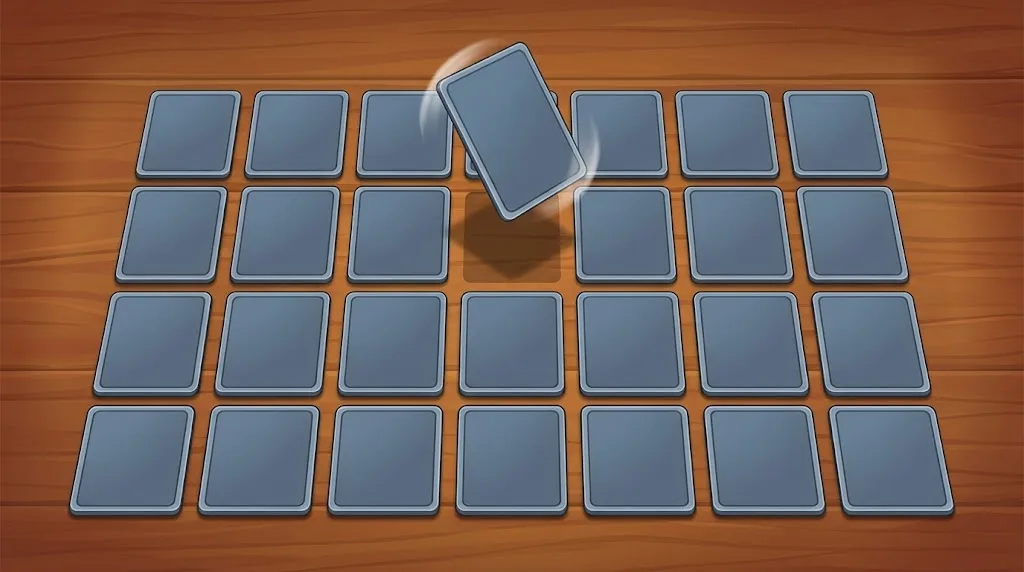
Match Maker Strategy: How to Win
Match Maker rewards the player who remembers the most cards, including the ones other people flip. A few simple habits make a big difference.
The one thing that matters most
Watch every flip, not just your own. Every card turned over is shown to the whole table. Most of what you need to know comes from other players’ turns.
A pair you can name the moment your turn starts is a free point. And because a match lets you go again, one turn with a good memory can clear several pairs in a row.
Split the board into zones
A board of 36 or 48 cards is too big to hold as one picture. Break it into smaller parts. Think of it as four corners, or as top, middle and bottom rows.
Then remember each card by its zone and its place in it: “top left corner,” “second from the right, bottom row.” A short label is far easier to recall than a spot in a big grid.
Edges and corners are the easiest places to remember. Cards in the middle of the board are the hardest. Give those a little more attention when they show.
As pairs leave the board, they leave gaps behind. The other cards stay where they are. Use the gaps as landmarks: “just left of the hole.”
Keep your phone the same way up for the whole game. If you turn it, the board can lay itself out with a different number of columns, and your map of it changes.
Say the names in your head
When a card flips, name it with its color and its shape: “red star, top right.” Saying it in words gives your memory a second way to hold it.
Use both color and shape. Some cards share a color, so “the blue one” is not enough to tell two cards apart.
Repeat the cards you know when there is a quiet moment, such as while a bot or another player takes their turn. A quick run through your list keeps it fresh.
Track what other players flip
- When a turn ends with no match, both cards stay up for a moment before they turn back. Use that moment to name them and place them.
- If someone flips a card you have already seen, its twin is now known. Note it. That is your next pair if they do not take it.
- Pay extra attention to the first card of each turn. If it matches something already seen and the player misses it, that pair is still sitting there for you.
- Once a pair leaves the board, forget it. Clear it from your list so there is room for the cards still in play.
Turn tactics: which card to flip
If you already know where both cards of a pair are, flip them first. Take every sure pair before you try anything else. Each match gives you another turn.
When you do not know a sure pair, flip an unknown card first. If its twin is a card you have seen before, you can go straight to it for a match.
If the first card is new and you have not seen its twin, you have a choice for the second card.
- Flip another unknown card. You might get lucky, and you learn one more card. But everyone else learns it too.
- Flip a card you already know. You will not match, but you give the table nothing new to remember.
When to play safe and when to explore
Early in the game, explore. Most cards are unknown, a lucky match is possible, and every new card helps you as much as anyone.
Late in the game, when a lot of cards are known, play safe. A new card you turn over could hand the next player a pair. Flipping a known card as your second keeps the board the way it is.
With players who are good at remembering, play safe sooner. With beginners or young kids, keep exploring longer.
Use the flip clock
You have 30 seconds per flip on Easy and 15 on Medium and Hard. The clock starts again after your first card and after each match. That is plenty of time to think.
Use a few seconds before your first flip to run through what you know. Do not rush into a card you have not thought about.
But do not let the clock run out. A card is then flipped for you at random, and you lose your choice. The countdown shows over the board in the last 5 seconds. Treat it as a warning.
Common mistakes
- Looking away on other players’ turns. That is where most of the cards are shown.
- Remembering color only. Two different shapes can share a color.
- Flipping a known card first when its twin is unknown. Flip the unknown one first, so you can still use what you know.
- Missing a sure pair. If you saw both cards, take them before you explore.
- Turning over new cards late in the game and handing the next player a pair.
- Trying to remember the whole board at once. Use zones and focus on the cards still in play.
Playing against bots
Bots take their turns in order and wait about a second before each flip, so you can watch every card they turn. Their flips teach you the board just like anyone else’s do.
Bots remember the cards they see, but their memory fades. An Easy bot forgets within a few turns, a Medium bot holds on a little longer, and a Hard bot remembers most of the board for a long while.
So beat them on time. A card seen many turns ago is one a bot has likely lost, so if you still know it, that pair is yours.
Start against Easy bots to build the habits in this guide, then move up to Medium. A Hard bot beats most players, so it takes your best memory.
Playing solo
Solo, every turn is yours, so there is no reason to play safe. Explore freely and try to clear the board with as few wrong cards as you can.
It is a good way to practice zones and naming. Try Hard once Easy feels simple.
Playing with a group or with kids
Match Maker is a great game for mixed ages. Young kids often have sharp memories and can beat adults who are not paying attention.
With kids, start on Easy. Twenty cards and 30 seconds per flip give everyone time. Say the cards out loud together as they flip. It helps them remember and keeps everyone watching.
On a TV at a party, the whole room sees every flip on the big screen. Everyone can follow the board, even players waiting for their turn.
Quick tips
- Watch every flip, especially other players’.
- Split the board into zones and remember cards by zone.
- Name each card by color and shape.
- Take every pair you are sure of first.
- Flip an unknown card first, a known card second when you want to play safe.
- Explore early, play safe late.
- Keep your phone the same way up.
- Do not let the flip clock run out.
Questions
- How do you win at Match Maker?
- Collect the most pairs. Watch every card that is flipped, by you and by others, and take every pair you are sure of the moment your turn starts. A match lets you go again, so one good turn can win the game.
- What is the best strategy for a memory card game?
- Flip an unknown card first. If you have seen its twin, go get it. If not, flip a known card second late in the game, so you do not show the next player anything new. Early on, explore.
- What are some tips for memory games?
- Break the board into zones, like corners and rows. Name each card in your head by color and shape and where it is. Watch other players’ turns, and repeat the cards you know while you wait.
- Should you flip a card you know or one you don’t?
- Flip an unknown card first, because it might match one you have seen. For your second card, flip another unknown early in the game, and a known card late in the game to avoid giving away pairs.
- Is Match Maker good for kids?
- Yes. Start on Easy, with 20 cards and 30 seconds per flip. Saying the cards out loud as they flip helps kids remember and keeps everyone watching the board.