Zinger Strategy: How to Win
Zinger is won by votes, and the votes come from the people at your table. Here is how to write answers they pick, and where the points really are.
The one thing that matters most
You are not writing the funniest answer in the world. You are writing the answer that more of this table will tap than the one beside it.
Every matchup is decided by the players who are not in it. They see two answers with no names, in a shuffled order, and tap one. They cannot vote for a friend or against the leader, because they do not know who wrote what. All they have is the line itself.
So write for the room you are in. A joke that makes one person cry laughing and leaves the rest cold loses to a joke that makes everyone smile.
How to write an answer that wins votes
- Answer the prompt. If it asks for a name, write a name. If it asks for a slogan, write a slogan. A line that fits the prompt exactly beats a funnier line that wanders off it.
- Be specific. For “A terrible name for a cruise ship”, “The Bad Boat” is flat. “The Slightly Damp” paints a picture.
- Go past your first idea. The first joke you think of is often the first one your opponent thinks of too, and two answers that are alike split the room by chance.
- Keep it short. You have 45 characters, and voters get a few seconds to read both answers before the vote opens. A line they get at a glance wins over one they have to work out.
- Make it work out loud. A TV in the room reads the answers out when it can, so a line that sounds funny beats one that leans on spelling or symbols.
- Use what the whole table knows. A running joke from earlier in the night works when everyone was there for it. It is a wasted card when the voters were not.
- Keep it clean enough to stay up. A blocked word is refused, and the host can hide an answer during the vote. A hidden answer scores nothing.
Use the clock
In rounds 1 and 2 you have 75 seconds for two answers, and both cards are on your screen from the start. Read both prompts first. Start with the one that gives you an idea straight away, then give the rest of the time to the harder one.
An answer is locked the moment you press Send, so read it once before you do. But do not sit on a finished answer. The writing ends as soon as everyone has sent both cards, and an empty card when the clock runs out is the worst result there is.
The final gives you 45 seconds for one answer. That is more time for each line than the earlier rounds, so use it.
Help me and empty cards
If a card is still empty when time runs out, the house writes it and it scores nothing, even if it takes every vote. Any answer of your own is worth more than that.
Help me fills in a house answer for half points. A Help me line that wins two votes in round 1 pays 100, where your own line would pay 200. It is there for when you are stuck, and it beats an empty card every time.
If you have a few seconds left, a weak line of your own is often the better bet. It needs only half the votes of a Help me answer to pay the same.
Reading the room
After every matchup, the result shows who voted for each answer and who wrote it. That is free information, and it comes in on every matchup, not just your own.
- Watch what wins. Does this table go for silly, dry or strange? Whatever took the votes in round 1 is your guide for round 2.
- Watch who votes for what. You do not know which players will vote on your answers, so aim for the taste most of the table shares.
- Watch your opponents’ lines. You face two different players each round, and you are not told who while you write. Knowing how each person writes tells you what your answer has to beat.
- Notice what gets a sweep. An answer that takes every vote is the clearest sign of what this room finds funny.
The scoring math
A vote is worth 100 in round 1 and 200 in round 2. Taking every vote in a matchup adds one more vote’s worth, as long as at least two votes were cast.
At a table of five, each matchup has three voters. In round 1 a 2 to 1 win pays 200 against 100. A clean sweep pays 400 against nothing. In round 2 those become 400 against 200, and 800 against nothing.
You are in two matchups a round. So the most you can take from round 1 is 800, and from round 2 it is 1,600. In the final at a table of five, four other players each give three medals, and the most one answer can take is four golds: 1,200.
- Round 1: half the stakes. Try things and learn what the table laughs at.
- Round 2: the biggest round. Two sweeps here are worth more than a perfect final. Put your best lines here.
- The sweep: the bonus turns a 3 to 0 win into four votes’ worth, double what a 2 to 1 win pays. A bold line that might take every vote can be worth the risk.
- Short games skip round 2, so the final carries more of the total. Do not coast into it.
Winning the final
The final works differently. Everyone answers the same prompt, and every player gives a gold, a silver and a bronze to three answers that are not their own. Gold is 300, silver 200, bronze 100.
At a table of five, each voter has four answers to choose from and three medals to give. So one answer misses out on each voter’s list. Your first job is not to be that answer.
Being liked by everyone beats being loved by one. Four silvers pay 800. One gold and nothing else pays 300. In the final, aim for the line the whole table puts somewhere on its list.
Everyone has the same prompt, so the obvious joke will be written more than once. The answer that stands apart from the others is the one voters remember when they give out the gold.
Give all your medals and tap Lock in. Medals that are not locked in when the clock runs out do not count.
Voting
You score nothing for voting, so there is nothing to gain from a clever vote. Vote for the answer you like better, and vote fast: a matchup closes as soon as everyone has voted, and the game moves quicker.
Do not try to guess the writer. The order is shuffled and the names are hidden until after the vote. A vote against a line because you think the leader wrote it is a guess, and when it is wrong you have handed points to the leader anyway.
Your vote also teaches the table. The result shows who voted for what, so other players learn your taste as you learn theirs.
Common mistakes
- Leaving a card empty. The house writes it and you score nothing, whatever the votes.
- Leaning on Help me. It is half points every time.
- Writing an inside joke that one voter gets. You need most of the voters, not one.
- Writing the first, most obvious answer, which your opponent may write too.
- Spending the whole clock on one card and rushing the other. Each matchup is worth the same.
- Saving your best material for round 1. Round 2 pays double.
- Forgetting to tap Lock in in the final.
Playing against bots
A bot writes one of the house’s answers for its prompt. Those answers are written to be funny, so a bot’s line is a fair one to beat. An easy bot draws from all eight house answers, a medium bot from the first four, and a hard bot from the best two.
Bots score half for their votes, because their answers are the house’s. You score in full for your own. Over a game, that is a big edge for any person who writes both cards every round.
Bots vote by chance with a lean toward people. An answer you wrote yourself is four times as likely to get a bot’s vote as an ordinary house answer, and twice as likely as one of the house’s best two. Against a hard bot, each bot voter picks your own line about two times in three.
That lean is for your own words. A Help me answer is a house answer, so it gets half points and no extra pull with bot voters. Against bots, always write your own.
Set the bots to hard in the lobby if you want a tougher game. Their lines are the house’s best, and bot voters like those more than the rest.
Playing with a group or with kids
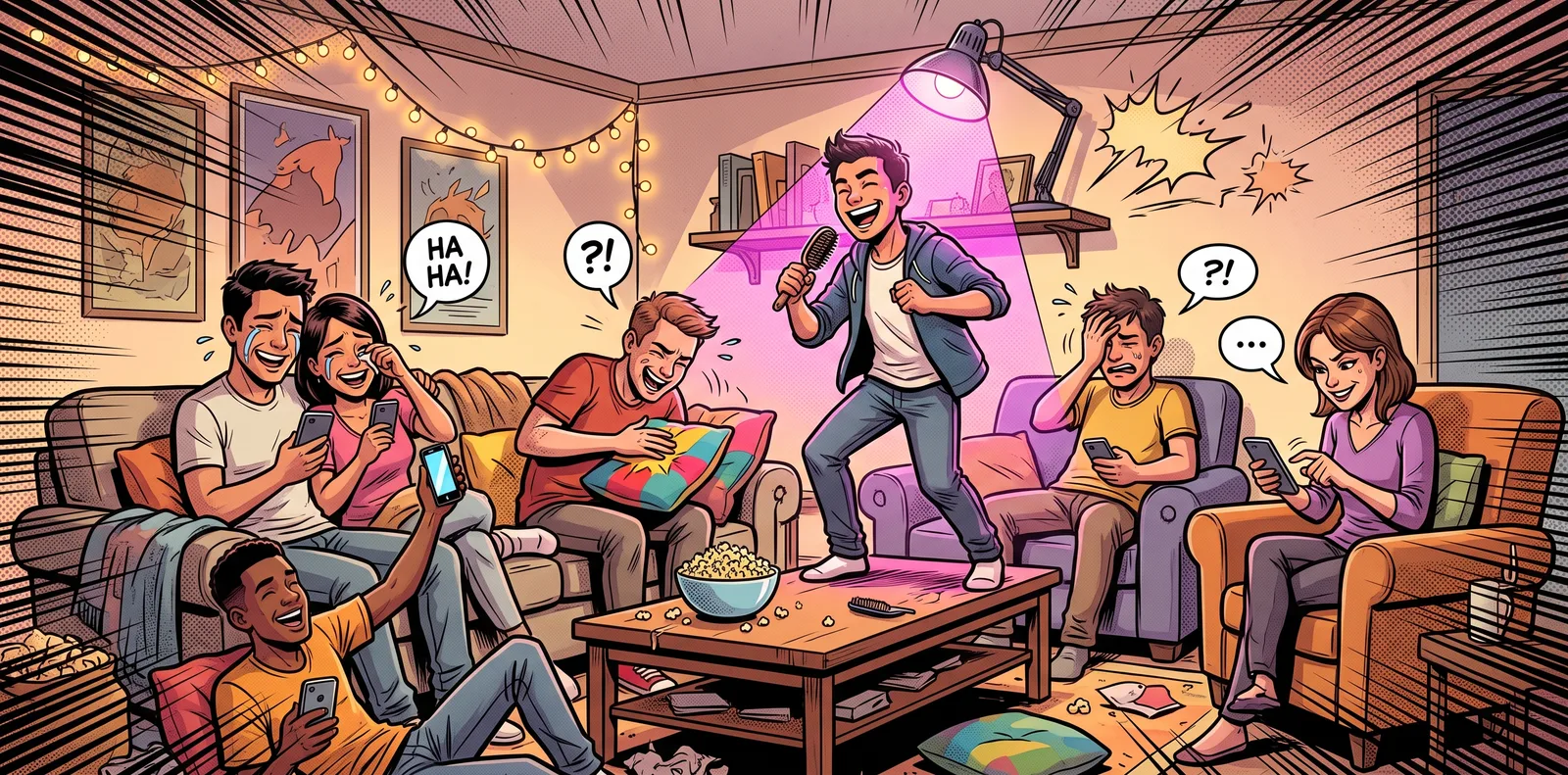
Put the game on a TV with joinme.games/watch. The TV reads each matchup out and the whole room sees the votes land and the names come out together. That reveal is where the laughs are.
With kids, the host can pick Kids prompts when setting up. The host also has a Hide button beside each answer during the vote, for anything that should not stay up.
In a mixed group, write for the youngest and the oldest voter at once. The line everyone understands wins more votes than the clever one half the room misses.
At a bigger table every matchup has more voters, so each one is worth more points and a sweep is harder to get. With more than eight players, the first eight to join write and the rest vote on everything.
Quick tips
- Write for this table, not for yourself.
- Answer the prompt in the shape it asks for.
- Specific beats vague. Short beats long.
- Skip your first idea if it is the obvious one.
- Never leave a card empty.
- Your own weak line usually beats Help me.
- Put your best lines in round 2.
- In the final, aim to be on everyone’s list.
- Lock in your medals.
Questions
- How do you win at Zinger?
- Write answers that most of the table will vote for, not just one person. Never leave a card empty, save your best lines for round 2, where every vote is worth double, and in the final aim to get a medal from every player.
- How do you write a funny answer in Zinger?
- Answer the prompt in the shape it asks for, be specific, and keep it short enough to read at a glance. Skip the first, obvious joke, because your opponent may write it too. Write for the people in the room.
- Should I use Help me in Zinger?
- When you are stuck, yes. It scores half points, and an empty card scores nothing. But a line of your own scores in full, so it needs half as many votes to pay the same.
- What is a clean sweep worth in Zinger?
- An answer that takes every vote in its matchup, with at least two votes cast, earns one more vote’s worth: 100 extra in round 1 and 200 extra in round 2. At a table of five, a sweep in round 2 pays 800.
- Which round is worth the most in Zinger?
- At a table of five, round 2. You can take up to 1,600 from your two matchups there, against 800 in round 1 and 1,200 in the final. In a short game there is no round 2, so the final matters more.
- How do you beat the bots in Zinger?
- Write your own answer on every card. Bots write house answers and score half for them, and when bots vote they are far more likely to pick a line a person wrote than a house answer.