Mahjong Solitaire Rules: How to Play
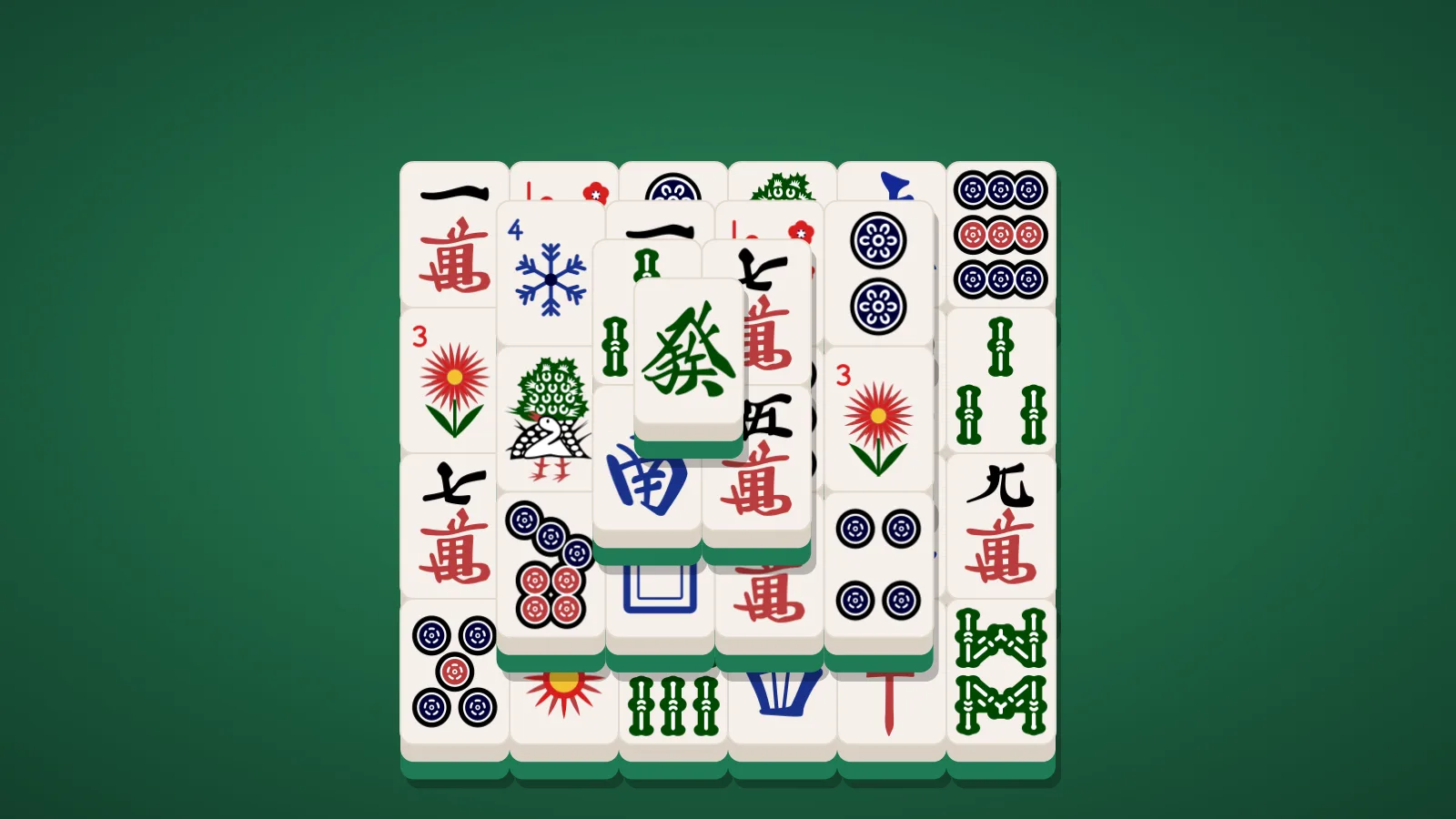
Mahjong Solitaire is the tile-matching puzzle: clear a pile of mahjong tiles two matching tiles at a time. Here the pile is in 3D, and you can race friends on the same pile or share one pile and play for points.
What you need
A phone, tablet or computer with a browser. Each player uses their own device.
One player is enough. Play alone, against bots, or with friends.
The tile-matching puzzle
Mahjong Solitaire is a puzzle played with mahjong tiles. It is not the four-player game of Mahjong, and you do not need to know that game. You match tiles that look the same.
The tiles are stacked in a pile, several levels high in the middle. You take the pile apart two matching tiles at a time. The catch is that you may only take tiles that are free.
The pile is in 3D. You can move it, turn it and zoom in to look around. Clear every tile and the pile is done.
The tiles
A full set has 144 tiles.
- Three suits, Characters, Dots and Bamboo, numbered 1 to 9, with four of each tile: 108 tiles.
- Four winds, East, South, West and North, with four of each: 16 tiles.
- Three dragons, Red, Green and White, with four of each: 12 tiles.
- Four flowers and four seasons, one of each: 8 tiles.
Matching pairs
Two tiles match when they show the same face, suit and number both. A 5 of Dots matches another 5 of Dots, not a 5 of Bamboo.
The flowers and seasons are the exception. Any flower matches any other flower, and any season matches any other season. A flower never matches a season.
There are four tiles of every face, so each face makes two pairs. The four flowers make two pairs between them, and so do the four seasons.
Which tiles are free
You can only take a tile that is free. A tile is free when no tile lies on top of it, not even partly, and its left side or its right side is open, with no tile against it on the same level.
- Only the left and right sides count. A tile in front of it or behind it does not block it.
- A neighbor that sits half a step forward or back still blocks that side. On the Big pile, the single tile at the left end touches both middle rows, so it blocks the first tile of each. The tiles at the right end do the same.
- In a long row, only the two end tiles can be free. The rest come free one at a time as the row is taken from its ends.
- Blocked tiles are shaded darker, so the free ones stand out. Tap a blocked tile and it gives a small shake, and nothing else happens.
The piles
The host picks one of two piles before the deal. A new pile builds itself on the table one level at a time.
Every deal can be cleared: there is always at least one order of pairs that takes the whole pile away. You can still get stuck by taking pairs in a bad order.
- Big: all 144 tiles in the classic shape often called the Turtle. It has five levels: a wide ground floor, then 36 tiles, 16 tiles and 4 tiles stacked in the middle, and one tile on the very top.
- Small: 32 tiles on two levels, 24 below and 8 on top. It uses 16 pairs drawn from the full set, so the tiles change from deal to deal. Good for a short round.
Race or Together
- Race: everyone gets their own copy of the same pile and clears it on their own device. The first to clear it wins.
- Together: one shared pile for the whole room. Players take turns, one pair a turn, and pairs score points. The most points when the pile is cleared wins.
Setting up
- Host a room and share the room code or invite link, or play on your own.
- Add bots in the lobby if you want them.
- Start the game. Everyone gathers on the game screen.
- The host picks how to play: Race or Together.
- The host picks the pile: Big (144 tiles) or Small (32 tiles).
- For a race, the host can set a time limit of 5, 10 or 15 minutes, or none.
- The host taps Deal. The choices are remembered on the host’s device for next time.
How a race goes
- Everyone gets the same pile at the same moment, and your clock starts.
- Tap a free tile and it lifts. Tap its match and the pair flies off the pile.
- To put a tile back down, tap it again or tap the table. Tapping a different free tile that does not match picks that one up instead.
- The players’ strip shows every racer: a small view of their pile from above and the number of matches they have made. One match is one pair. The strip runs along the top, or down the left side when your screen is wider than it is tall.
- Your time locks in when your last pair goes. Then you see the standings so far while you wait for the others, along with your best time for that pile on this device.
- The race ends when every racer has cleared the pile or stopped, or when the time limit runs out.
Hint, undo and shuffle in a race
- Hint: the bulb lights a pair for you. It looks for one that keeps the pile clearable. It is free, as often as you like.
- Undo: takes back your last pair. Tap it again to go back further. Undo is free.
- No pairs left: when no two free tiles match, you get two buttons, Shuffle and Stop here. You can also undo your way back out. There is no shuffle while a pair is still on the table.
- Shuffle: lays the tiles still standing out again on the same spots, so the pile can be cleared again. It adds 60 seconds to your clock.
- Stop here: ends your race with the matches you have made.
How Together goes
Together has no undo and no shuffle button, and the bulb works on your turn only. You can still move and turn the pile while you wait.
- One pile is dealt for the whole room. Everyone in the room at the deal has a seat, bots too, in the order they joined the room. The player who joined first goes first.
- The first turn’s clock starts once the pile has finished building.
- On your turn, take one pair: tap a free tile, then its match. You have 30 seconds.
- The pair flies to you, your points go up, and the turn passes to the next player. A match does not give you another turn.
- If your 30 seconds run out, the turn passes on with nothing taken.
- The players’ strip lists everyone in turn order and lights the one whose turn it is. Each card shows that player’s lead, which is their points above the lowest score at the table, and the tiles and sets they have taken.
- The game ends when the last pair leaves the table.
Points in Together
- A pair of suit tiles (Characters, Dots or Bamboo): 2 points.
- A pair of winds or dragons, a pair of flowers, or a pair of seasons: 4 points.
- Set bonus: take the second pair of a face when you also took the first, so all four tiles are yours, and you get 4 extra points. That makes the second pair worth 6 for a suit tile and 8 for a wind or dragon.
- Flowers and seasons work the same way. Take both flower pairs, or both season pairs, and the second is worth 8.
- The bonus goes to a player who took both pairs. If someone else took the first pair, the second scores its plain points.
- No pairs left: if the pair you take leaves the pile with no pair, the tiles still standing are laid out again at once and you lose 4 points. You still score the pair first, and your score never drops below zero.
Scoring and winning
- Race: the first to clear the pile wins. Everyone who cleared it is ranked by time, fastest first.
- Race, not cleared: anyone who did not clear the pile comes after every finisher, ranked by matches made, most first. If two players made the same number, the one who reached it sooner on their own clock is ahead. A Big pile is 72 matches and a Small pile is 16.
- Race with a time limit: the race ends for everyone when the limit runs out. If nobody has cleared the pile by then, the most matches wins.
- Together: the most points when the pile is cleared wins.
- Together, level on points: the player who was quicker on average per turn is ahead. A turn that ran out counts as its full 30 seconds. Players level on points and on time share the place.
Every rule and edge case
- Ties in a race: times are kept to a fraction of a second, so a true tie is very rare. Racers who are level in every way share the place.
- Pausing: any player can pause the game for everyone, and any player can resume it. The pile is covered while it is paused. In a race your clock skips the paused time, and in Together the turn gets its time back.
- A late joiner: in a race, if you arrive more than a few seconds after the deal, you see “Race in progress” and join the next one. In Together, seats are set at the deal, so you watch this pile and get a seat at the next deal.
- Someone is away in Together: their turns are skipped while they are off the game screen, and their points still count. When they come back, their turns come back too. If they leave in the middle of their turn, it passes to the next player.
- A racer who never finishes: the race goes on. Once the host has cleared the pile or stopped, the host can end the race for everyone with End the race now.
- Undo after a shuffle: the tiles go back to where they were, but the 60 seconds stay on your clock.
- A stuck pile in Together: nobody shuffles by hand. The pile is laid out again by itself, and the player whose pair left it stuck pays the 4 points.
- The host leaves the game: the game ends for everyone and the room goes back to the lobby.
- Play again: after the final standings the host can start a new round, pick the mode, pile and time limit again, and deal a new pile.
Bots
The host can add up to three bots in the lobby, each set to easy, medium or hard.
In a race, each bot clears its own copy of the same pile and shows in the strip like any player. An easy bot plays at the pace of someone new to the game and stops to look now and then. A hard bot is quick.
Easy and medium bots sometimes grab the first pair they see, as people do, and can run out of pairs. Then they shuffle and take the same 60 seconds on their clock. A hard bot never takes a wrong pair.
In Together, bots take their turns in order after a short pause, shorter for harder bots. An easy bot takes any pair it sees. A medium bot looks for a pair that keeps the pile clearable. A hard bot goes for the pair worth the most to it, set bonus included.
Playing solo
Host a room on your own and deal. In a race you play against your own clock. Add bots if you want someone to beat.
Together works alone too. Every turn is yours, each with its 30 seconds, and you play for a high score.
Playing with friends anywhere
Host a room and send the room code or invite link. Friends open it on their own phones, wherever they are.
In a race, everyone sees the strip of piles and who is ahead. In Together, everyone sees the same pile and every pair as it is taken.
Playing as a party with a TV
Open joinme.games/watch on a TV or laptop and enter the room code.
In a race, the big screen shows the pile of the best placed racer still playing, in 3D and turning slowly, above every racer’s pile seen from above with their matches. In Together, it shows the shared pile turning slowly, with each player’s points and tiles under it and the player whose turn it is lit up. Both end with the final standings.
Everyone plays on their own phone. The TV only watches.
Controls
- Tap a free tile, then its match. Tap the tile again, or the table, to put it down.
- One finger moves the pile, like a map. Two fingers turn it in 3D, and a pinch zooms.
- The arrows button switches to rotate mode, where one finger turns the pile and two fingers move it. Your choice is remembered on your device.
- On a computer, drag to move the pile, right-drag to turn it, and scroll to zoom. Rotate mode swaps drag and right-drag.
- The corners button appears once you have moved the view. It brings back the view from above, fitted to the tiles still standing. Until you move the view yourself, it follows the pile as it shrinks.
- The half-dark tile button turns the shading on blocked tiles off and on.
- The bulb lights a pair. In a race, the turned-back arrow at the top is undo.
- The pause button, or P or Escape on a keyboard, pauses the game for everyone. The question mark shows the instructions, and the × leaves the game.
Questions
- How do you play Mahjong Solitaire?
- Clear the pile two matching tiles at a time. Tap a free tile, then a free tile with the same face, and the pair leaves the pile. A tile is free when nothing lies on it and its left or right side is open. Clear every tile to finish.
- Which tiles can you remove in Mahjong Solitaire?
- Only free tiles. A tile is free when no tile lies on top of it, even partly, and no tile is against its left side or its right side. Here the blocked tiles are shaded darker, and a blocked tile shakes if you tap it.
- Do flower and season tiles match each other?
- Any flower matches any other flower, and any season matches any other season, even though they look different. A flower does not match a season. Every other tile needs an identical partner.
- Is every Mahjong Solitaire game winnable?
- Here, yes. Every deal can be cleared. If you take pairs in a bad order and run out, a race lets you undo for free or shuffle the tiles still standing for 60 seconds on your clock, and the pile can be cleared again.
- How many tiles are in Mahjong Solitaire?
- The Big pile uses all 144: 108 suit tiles, 16 winds, 12 dragons, 4 flowers and 4 seasons. The Small pile uses 32 of them, in 16 pairs.
- Can you play Mahjong Solitaire with friends?
- Yes. In Race, everyone clears a copy of the same pile and the first to finish wins. In Together, everyone shares one pile, takes one pair a turn, and the most points wins. You can also play alone or against up to three bots.