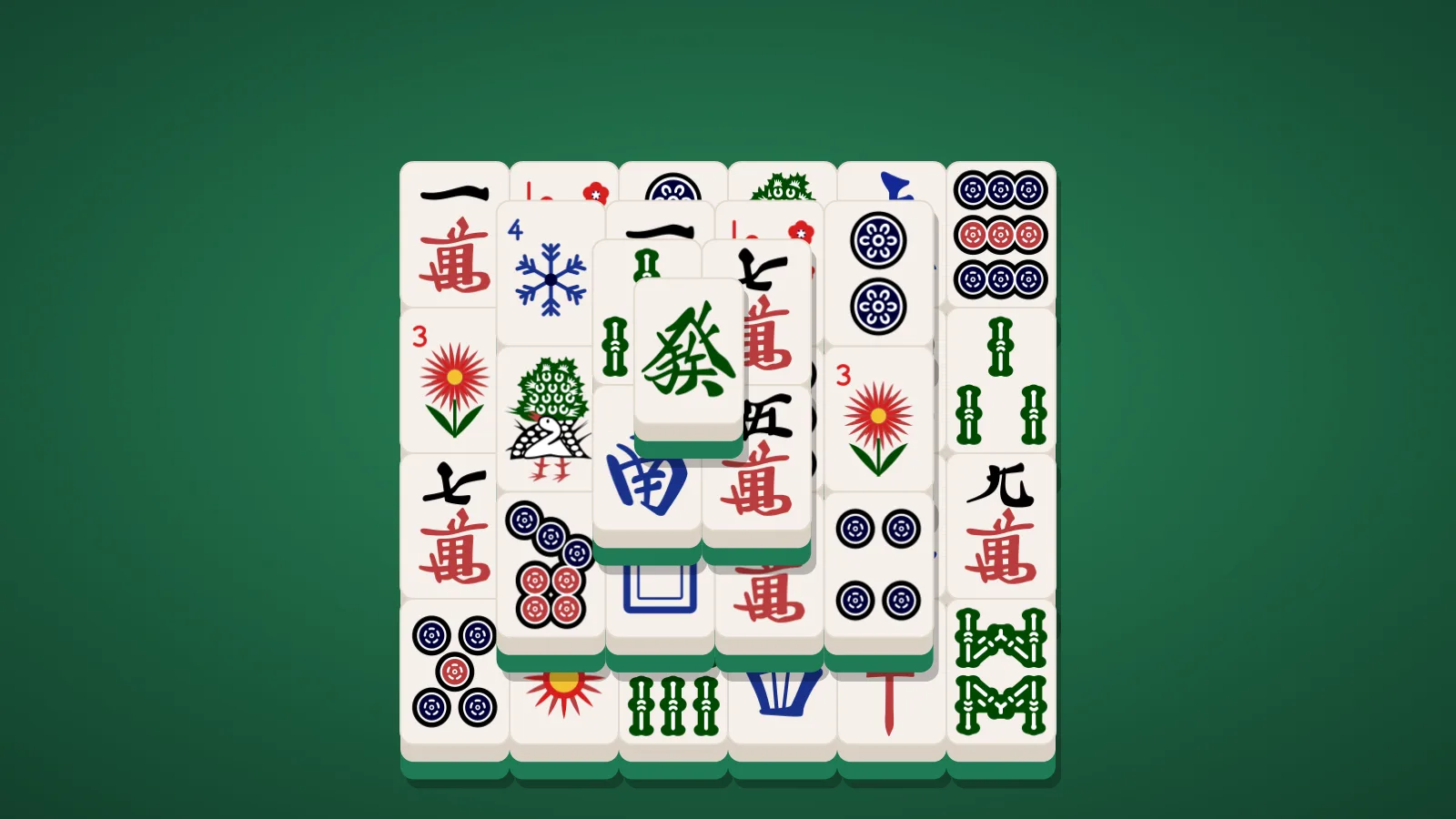
Mahjong Solitaire Strategy: How to Win
Mahjong Solitaire looks like a matching game, but it is won by choosing which match to take. The right pair opens the pile. The wrong one locks it.
The one thing that matters most
Take the pair that opens the most tiles, not the first pair you see. Every tile you lift can free the tiles under it and beside it. A pair that frees nothing leaves you with fewer choices than you had before.
That one habit decides both modes. In a race, a pile with plenty of free tiles is quick to clear, and a pile with no pairs left costs you a minute. In Together, the same look ahead tells you what you are about to open up for the next player.
Read the pile before you tap
Blocked tiles are shaded darker. Leave the shading on. The bright tiles are the ones you can take, and you can scan them in a second.
Play from the view from above. No free tile is covered there. If you leave the view alone, it fits itself to the tiles still standing, so the tiles get bigger as the pile shrinks.
Turn the pile when you want to see how tall a stack is. A pair that uncovers a tall stack is worth more than one from a flat edge. Then tap the corners button to bring the view from above back.
Take high tiles and row ends first
- The top of the Big pile first. It lies on four tiles at once, and none of them can move until it goes.
- Then the upper levels. A tile on top of a stack blocks everything beneath it.
- Work both ends of the long rows on the ground floor. A row gives up one tile at a time from each end, so the long rows are the slowest part of the pile to open.
- Clear the side tiles of the Big pile early. Until they go, the two middle rows cannot be taken from that end.
- Leave loose tiles on low, short rows for later when taking them frees nothing. They are not in anyone’s way.
Choosing between copies of a tile
There are four tiles of each face, so you often have a choice of which two to pair.
- Every tile of that face still on the table is free: take them. That can never hurt the pile.
- Three free: take the two that open the most. The third waits for the fourth.
- Two free and two still hidden: if the pair opens something, take it. If it opens nothing, it can wait until you see where the other two are.
- Flowers and seasons give you more choice, because any flower goes with any other flower and any season with any other season. With three free, pick the two that open the most.
The trap to know about
One position cannot be cleared by any order of pairs: the last two tiles of a face, with one lying over the other in the same stack. The lower tile is not free while the upper one stands, and the upper one has no other partner left.
You avoid it by using the high tile early. When a tile on top of a stack has a free match, take that pair before you spend the other copies somewhere else.
When it happens anyway, the pile runs out of pairs sooner or later. In a race that means an undo or a shuffle. In Together the pile is laid out again and someone pays 4 points.
Racing: speed without getting stuck
In a race the fastest clear wins, and nothing else counts. Hints are free and undo is free. The shuffle is what costs you: 60 seconds on your clock.
- Keep your eyes moving. Scan the bright tiles for a face you can see twice, rather than picking one tile and hunting for its partner.
- Use the bulb the moment nothing jumps out. It is free, and it looks for a pair that keeps the pile clearable. A few seconds of staring costs more.
- Check the number as well as the suit. Tap a free tile that does not match and it is picked up instead, which costs you a moment.
- On a phone, pinch to zoom in when the faces are hard to tell apart. The Big pile is wide.
- Do not turn the pile without a reason. Check the stack, then go back to the view from above.
Stuck? Undo first, then decide
When “No pairs left” shows, do not tap Shuffle straight away. It adds 60 seconds. Undo costs nothing but the taps.
Take back a few pairs, then tap the bulb. It looks for a pair that keeps the pile clearable from where you now stand, so it steers you around the mistake.
Undo wins when the mistake was recent. If you would have to take back and replay more than a minute of pairs, shuffle. After a shuffle the pile can be cleared again. Undoing a shuffle does not give the minute back.
Racing against a time limit
With a time limit, a race that nobody finishes is decided by matches made. So the plan changes once you can see you will not clear the pile: stop planning and take every pair you can find.
Stop here freezes your count, so leave it alone while there is time left. If you are stuck, undo or shuffle and keep matching.
Players level on matches are split by who got there sooner on their own clock. A pair now beats the same pair later.
Together: know what each pair is worth
Together is one pair a turn, and a match does not earn another turn. So every turn is a choice between the pairs on the table, and the points decide it.
- A suit pair is 2. A pair of winds, dragons, flowers or seasons is 4.
- The second pair of a face you already hold adds 4: it is worth 6 for a suit tile and 8 for a wind, dragon, flower or season.
- So the order is simple. Finish a set first, then take a 4, then a 2.
- The set bonuses add up. On the Big pile the pairs are worth 180 points in all, and the set bonuses can add up to 144 more.
Building and blocking sets
- Remember which faces you took a first pair of. The strip shows how many sets each player has, not which faces they are waiting on.
- Watch what the others take. When the second pair of a face a rival holds comes free, it is worth 6 or 8 to them and its plain points to you. Taking it yourself costs them the bonus.
- A free second pair is exposed until your next turn. With two players, your rival gets one turn to take it. In a bigger group, everyone gets one.
- The flowers count as one face, and so do the seasons. Take a flower pair and the other flower pair is your set.
- On the Small pile many faces have just one pair, so sets are rare. Count on the 4-point pairs there.
Do not pay the 4 points
If your pair leaves the pile with no pair, the pile is laid out again and you lose 4 points. Late in a pile, before you take a pair, check that another pair will still be free after it.
The numbers tell you how much it hurts. A suit pair that sets off the penalty leaves you 2 points down. A 4-point pair breaks even. A set still comes out ahead.
The bulb helps here. On your turn it looks for a pair that keeps the pile clearable. It does not look at points, so use it as a safety check, not as advice on what scores best.
Use the other players’ turns
You can move and turn the pile while others play. Use that time to line up your pair, and a second choice in case someone takes the first.
Play promptly. If the game ends level on points, the quicker average turn wins. A turn that runs out scores nothing and counts as a full 30 seconds.
Common mistakes
- Taking the first pair you see instead of the one that opens the most.
- Leaving the top tile and the tall stacks for later.
- Shuffling when a few undos would do.
- Tapping Stop here while a time limit is still running.
- In Together, taking a 2 when a set or a 4 is on the table.
- In Together, forgetting which faces you hold a first pair of.
- In Together, taking the last pair in sight without checking what it leaves.
Playing against bots
In a race, an easy bot plays slowly, stops to look, and sometimes takes a pair that spoils its pile. It then pays for a shuffle like anyone. A steady player who does not get stuck beats it.
A hard bot is quick and never takes a wrong pair, so it never needs to shuffle. To beat it you cannot afford a shuffle either. Keep a rhythm, and use the bulb the moment you stall.
In Together, an easy bot takes any pair it sees, so it leaves sets and 4-point pairs on the table for you and can walk into the penalty. A medium bot looks for safe pairs and does not chase points. A hard bot goes for the pair worth the most to it and finishes its sets, so take the second pair of its faces when you can.
Playing with a group or with kids
The tiles need no reading. Kids can match them by picture. Explain the flowers and seasons before you start: they match by kind, not by picture.
Start on the Small pile. It has 32 tiles and makes a short round.
For a mixed group, Together keeps everyone on the same pile, and 30 seconds a turn gives a beginner time to find a pair. In a race, set a time limit, so the round ends for everyone at once and slower players still earn a place by matches.
Quick tips
- Take the pair that opens the most tiles.
- High tiles and row ends first.
- Keep the shading on and play from above.
- Use the bulb as soon as you stall. It is free.
- Stuck in a race: undo a few pairs before you pay 60 seconds for a shuffle.
- In Together: sets first, then 4s, then 2s.
- Never leave the pile without a pair on your turn.
Questions
- How do you win at Mahjong Solitaire?
- Clear every tile. Take pairs that free the most tiles, start with the top of the pile and the ends of the long rows, and do not take a pair just because you can see it. In a race here, the fastest clear wins.
- Which tiles should you remove first in Mahjong Solitaire?
- The ones that block the most. Start with the tile on the very top, then the upper levels, then the ends of the longest rows and the side tiles. Pairs that free nothing can wait.
- What do you do when there are no more moves in Mahjong Solitaire?
- In a race here you can undo for free or shuffle for 60 seconds on your clock. Undo a few pairs and tap the bulb first. Shuffle when the mistake is too far back. In Together the pile is laid out again by itself.
- Should you use hints in Mahjong Solitaire?
- Yes. Here the bulb is free and looks for a pair that keeps the pile clearable. In a race, tap it as soon as you stall. In Together it works on your turn and ignores points, so use it as a safety check.
- How do you score the most points in Together mode?
- Finish sets. The second pair of a face you already hold is worth 6 or 8 points, against 2 for a suit pair and 4 for winds, dragons, flowers and seasons. Avoid leaving the pile with no pair, which costs 4 points.