
Mahjong Traditional Rules: How to Play Riichi Mahjong
Mahjong Traditional is mahjong for four at one table: Japanese riichi with friends or bots, and Hong Kong, Chinese Official and American rules against bots. These are the rules of the Japanese table as the game plays them.
What you need
A phone, tablet or computer with a browser for each player. A TV or laptop can show the whole table to the room.
One player is enough: bots take every seat nobody sits in. Up to four people can play the Japanese table together, in one room or from anywhere.
The tiles
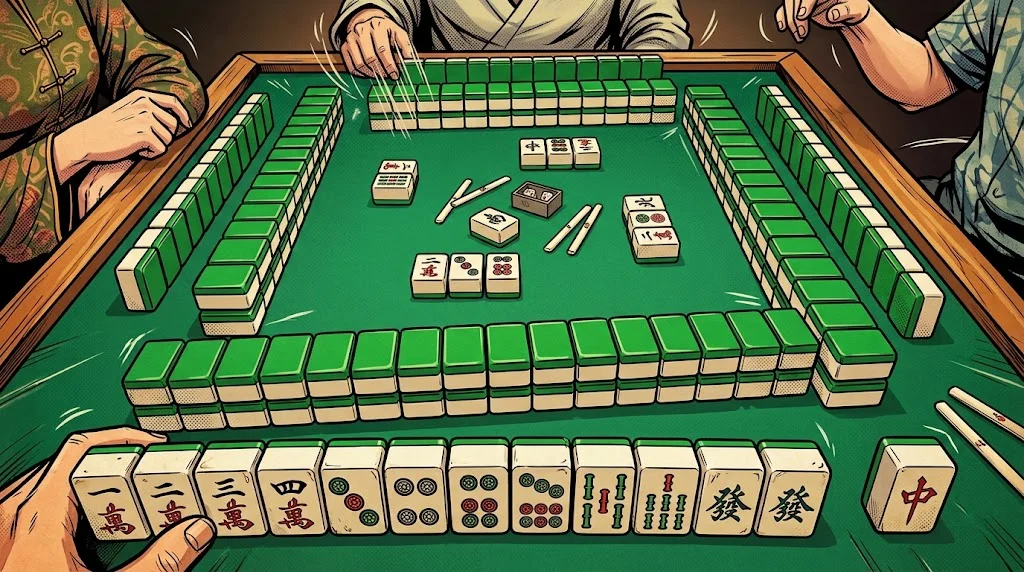
The Japanese table uses 136 tiles, four of each face, with no flowers or seasons.
- Three suits, Characters, Dots and Bamboo, numbered 1 to 9.
- Four winds: East, South, West and North.
- Three dragons: Red, Green and White.
- One 5 of each suit is red. With the red-fives option on, each one in a winning hand is worth an extra han.
The goal
Make a winning hand before anyone else: four sets and a pair, fourteen tiles in all. A set is three of a kind (a pon), three in a row in one suit (a chi), or four of a kind (a kan, which takes a replacement tile).
Two special hands win too: seven different pairs, and thirteen orphans (one of every 1, 9, wind and dragon, with one of them twice).
A winning hand also needs at least one scoring pattern. Four sets and a pair with no pattern cannot win.
A turn
- Each player starts with 13 tiles. The dealer starts with a 14th and discards first.
- On your turn, draw a tile from the wall. Your hand now has 14.
- Win with it (tsumo) if it completes your hand, or discard one tile into the middle.
- Play passes to the right, unless someone claims your discard.
Claiming a discard
When a tile is discarded, the other players may claim it before the next draw:
- Ron: the tile completes your winning hand. Ron beats every other claim.
- Pon: you hold two of that tile and take it to make three of a kind.
- Kan: you hold three of that tile and take it to make four of a kind.
- Chi: the tile completes a run of three. Only the player after the discarder may chi.
- Pass: let it go.
Open and closed hands
A set you make from a claimed discard is open: it is laid face up on the table. A hand with no open sets is closed.
Some scoring patterns need a closed hand, and only a closed hand can declare riichi. Claiming a tile gets you a set faster but can cost you value.
Riichi
With a closed hand that is one tile from winning, you may declare riichi as you discard. It costs a 1,000-point stick, which the next winner collects.
After riichi you may not change your hand: you discard the tile you draw unless it wins. Riichi is itself a scoring pattern, so a riichi hand can always win.
Dora
One tile of the dead wall is turned face up: the dora indicator. The tile after it is dora (after a 9 comes the 1 of the same suit; winds and dragons go round in order). Each dora in a winning hand adds a han.
Dora is not a scoring pattern by itself: a hand still needs one to win.
- Ura dora: with this option on, a riichi winner also counts the tile under each indicator.
- Kan dora: with this option on, every kan turns up another indicator.
Scoring patterns
A winning hand adds up the han of every pattern it has. These are the patterns the game knows:
- Riichi, and winning on your own draw with a closed hand (fully concealed).
- All simples: no 1s, 9s, winds or dragons.
- A triplet of dragons, of your seat wind, or of the round wind.
- Pinfu: a closed hand of runs, with a pair that scores nothing, won on a two-sided wait.
- A pure double run, a straight (1 to 9 in one suit), and a three-color run.
- All triplets, three concealed triplets, and seven pairs.
- Outside hands: every set and the pair hold a 1, 9, wind or dragon (or only 1s and 9s).
- Half flush and full flush: one suit, with or without honors.
- Little three dragons, and winning on the last tile of the wall or the last discard.
- Limit hands (yakuman): big three dragons, four concealed triplets, all honors, all terminals and thirteen orphans.
Points
Everyone starts with 25,000 points. A win is paid by han and fu, as in the standard Japanese tables; big hands are capped at mangan, haneman, baiman, sanbaiman and yakuman.
Win by ron and the discarder pays all of it. Win by tsumo and the other three pay, the dealer paying more. A dealer win is worth more than the same hand won by anyone else.
Each hand the dealer keeps adds a counter worth 300 more to the next win.
If the wall runs out with no winner, the players one tile from winning share 3,000 points from those who are not.
Hands and rounds
The dealer stays dealer after winning, or when the wall runs out with the dealer one tile from winning. Otherwise the deal passes to the right.
The round wind starts at East and moves on each time the deal comes back round to the first seat. Play goes on hand after hand until you stop: everyone presses Next hand to deal again.
Table options
The host picks these before the deal; each is on unless the host turns it off:
- Ura dora after riichi.
- Red fives count as dora.
- Extra dora for each kan.
- Head bump: when two players can ron the same discard, only the one nearest the discarder wins.
- Double wind pair: a pair of both the round wind and your seat wind scores 4 fu.
- Bots: easy, medium or hard. A harder bot makes fewer mistakes and claims more.
Playing together
Every phone at the table plays the same deal. Your own tiles are only on your phone; the TV shows the walls, the discards, the open sets and the points, never a hand in play.
A player who leaves the table for more than a couple of minutes on their turn gives their seat to a bot, so the others are never stuck waiting.
The Hong Kong, Chinese Official and American tables are played on the host's own phone against three bots.
Questions
- Is Mahjong Traditional free?
- Yes. It plays in the browser on a phone, tablet or computer, with nothing to install.
- Can I play Mahjong Traditional alone?
- Yes. Bots take every empty seat, at easy, medium or hard.
- How many people can play the Japanese table together?
- Up to four. Bots fill any seat nobody takes.
- Does a winning hand need a scoring pattern?
- Yes. On the Japanese table four sets and a pair are not enough: the hand needs at least one scoring pattern, such as riichi, all simples or a dragon triplet.
- What happens when the wall runs out?
- Nobody wins the hand. The players one tile from winning share 3,000 points from those who are not.

Play Mahjong Traditional
Mahjong for four by the rules you pick. Friends take seats at the Japanese table, and bots fill the rest.