
Mahjong Traditional Strategy: How to Win at Riichi
Riichi mahjong is won by the hand that gets ready first and loses least on the hands it cannot win. Most of the skill is in what you throw away.
The one thing that matters most
Count how many tiles you are from ready, and discard the tile that keeps that number lowest. A tile that sits in no run, no pair and no near-set is the first to go; a tile that can still become part of two sets is the last.
Every turn you keep a useless tile is a turn your hand does not move. The bots do this well, so a hand that drifts loses to them.
What to discard first
- Lone winds that are not yours or the round's, and lone dragons, early: they make no runs, and later in the hand they are the tiles someone else may be waiting on.
- Lone 1s and 9s next: a 1 only joins a run one way.
- Then the edge of a shape: from 1-2, the 1; from 8-9, the 9.
- Keep middle tiles (3 to 7) and pairs. Two pairs are worth keeping; five pairs are a hint to go for seven pairs.
Plan a scoring pattern early
A hand needs a pattern to win, and a ready hand with none is stuck. Decide by your second or third discard which one you are building.
All simples is the easiest: throw every 1, 9, wind and dragon. Riichi is the other sure one, so a closed hand always has a way to win.
A dragon pair, or a pair of your seat or round wind, is worth claiming into a triplet: it is a pattern on its own.
Six or more tiles of one suit is the start of a half flush, which doubles in value when you keep the hand closed.
When to claim a discard
- Claim when the set gives you your pattern (a dragon, your wind) or makes you ready.
- Think twice otherwise: an open hand cannot call riichi, and some patterns (pinfu, a closed flush's full value) are lost.
- Never claim yourself into a hand with no pattern left. Check the strategies card before you pon.
When to call riichi
Call it when your closed hand is ready on a good wait: a wait on two sides of a run, or on several tiles. It adds value, can turn up ura dora, and tells everyone else to be careful.
Think twice with a single-tile wait late in the hand, or when you are far ahead: after riichi you cannot change your hand or stop throwing the tile you draw.
Staying safe
When someone calls riichi, the tiles they have already discarded are safe to throw: a hand cannot win on a tile it threw away. Tiles four of which you can already see are safe too.
If your own hand is far from ready, stop chasing it and throw only safe tiles. Losing nothing on a hand you cannot win is as good as a small win.
Count the wall. Near its end, a hand one tile from winning collects points in a draw, so getting ready late is still worth it.
Read the table
- Tap a player's bar to see their open sets. Three sets of one suit means a flush: hold that suit back.
- Select a tile in your rack to see how many of it are already in the discards. A wait on a tile with three out is a wait on one.
- The dealer wins more and keeps the deal: stopping the dealer's hand is worth a cheap win of your own.
Playing with friends
On the TV, everyone sees the discards, the open sets and the points, but never a hand. Use it: what a friend throws, and what they stop throwing, tells you what they are building.
Pick the bots to match the table: easy bots make many mistakes, hard bots very few and claim more.
Questions
- What should I discard first in riichi mahjong?
- Lone winds and dragons that score nothing for you, then lone 1s and 9s, then the edge tile of a two-tile shape. Keep middle tiles and pairs.
- When should I call riichi?
- When your closed hand is ready on a good wait, such as either end of a run. Hold back on a single-tile wait late in the hand.
- How do I avoid dealing into someone's riichi?
- Throw the tiles they have already discarded, and tiles four of which you can see. A hand cannot win on its own discards.
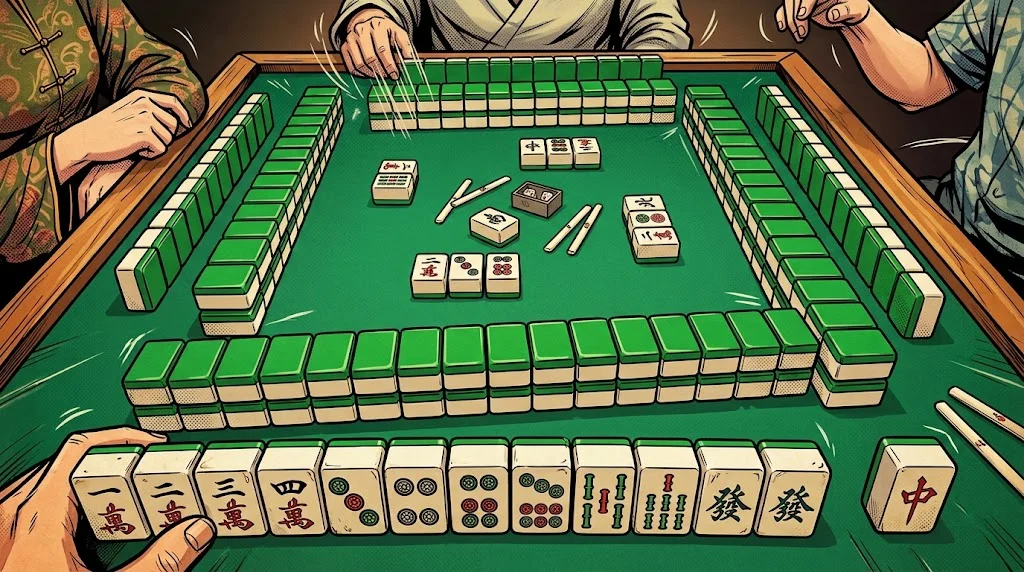

Play Mahjong Traditional
Mahjong for four by the rules you pick. Friends take seats at the Japanese table, and bots fill the rest.